

Student Stories: Christin Penz

My name is Christin Penz, and I’m studying the Creative Arts: Dimensions Unit 1.3, where I continue to explore language, participation, and installation as part of my artistic practice.
I’ve been involved in the art world for quite some time. I previously had a studio in Berlin, where I worked primarily with mixed media and printing techniques. Later, I became interested in screen printing and joined a community workshop dedicated to screen printing and analogue photography. After moving to the countryside, I felt a strong desire to learn again and to give my artistic practice a stronger theoretical foundation.
Since starting at OCA, I’ve been experimenting with approaches and media I never thought I would have the confidence to explore. The course has encouraged me to step outside my comfort zone, and I’m very happy that I decided to study with OCA. It has broadened both my practice and the way I think about making art.
Language Can Exclude - An ongoing poetry project


Over the past year I have been developing an ongoing collaborative poetry project called Language Can Exclude (LCE). The project started with a question that interested me for a long time: Who gets to speak, who is heard, and why are some voices considered more authoritative than others? Many texts that shape Western culture are still treated as authoritative today. They are taught, quoted and reproduced again and again. At the same time, they often represent only a limited range of voices. Rather than rejecting these texts, I wanted to work with them and see what happens when they are interrupted and transformed.
The idea of the project is very simple. Participants choose a short passage from a text they consider part of the Western canon - literature, philosophy, politics, religion, psychology or science. I intentionally ask participants to work with canonical texts rather than texts by marginalised authors. The aim is to question and transform voices that have traditionally held cultural authority, not those that have already been historically excluded. Using a small online tool I have created, the text is transformed by keeping every third word and rearranging the remaining words. No new words are added. Participants then add one question addressed directly to the reader or listener.

Although everyone follows exactly the same rule, every contribution is different. The original text, the chosen question and the person reading it all influence the final work. Some recordings are quiet, others more emotional. One participant even used an AI-generated voice, which made me think about authorship and who is actually speaking. When I first invited people to participate, I imagined the project as a series of collaborative texts. Since then, it has grown much further than I expected. So far it has developed into posters, audio recordings, a newspaper draft, installation ideas and a first video work. I now think of these as different iterations of the same project rather than separate works. Each one explores language, authority and participation from a slightly different perspective.
The project is continuing to develop. In September I will be filming an acting student in the Berlin State Library reading fragments of the transformed texts. Rather than showing all of the original contributors, one single performer will read texts written by many different people. I’m curious to see how this changes the work and what it says about voice, authorship and representation. I also see Language Can Exclude as a long-term project. All contributions will remain accessible through my website, where the archive will continue to grow. I hope to keep returning to these texts and voices in new ways, whether through installations, performances, films or live readings. I like the idea that the project can keep changing as more people contribute. One thing that surprised me was how much I enjoyed the collaborative aspect. At first I found it difficult to give participants complete freedom in choosing their texts and questions because I worried the project might lose focus. Instead, every new contribution opened up ideas I would never have had myself. The project became much richer because of other people’s voices.

I’d therefore love to invite more people to take part. It’s very simple:
Choose a short extract (around 150–300 words) from a text you consider part of the Western canon.
Transform it using my online tool. https://christinpenz.de/lce-text-transformer/
Add one question addressed directly to the reader or listener.
If you like, record yourself reading the transformed text aloud (a phone recording is absolutely fine).
If you like to take part, please send the collaboration to mail@christinpenz.de:
the original text,
the transformed text,
your question,
and, if possible, an audio recording.
Every contribution becomes part of the project. Your transformed text will be credited with your name and the original source, and it may appear in future posters, installations, films or performances.
I’d be delighted if you’d like to take part. Even if you don’t want to contribute, I’d really appreciate hearing your thoughts or feedback. The project keeps changing, and every conversation helps shape where it goes next.
All contributions and iterations on my website

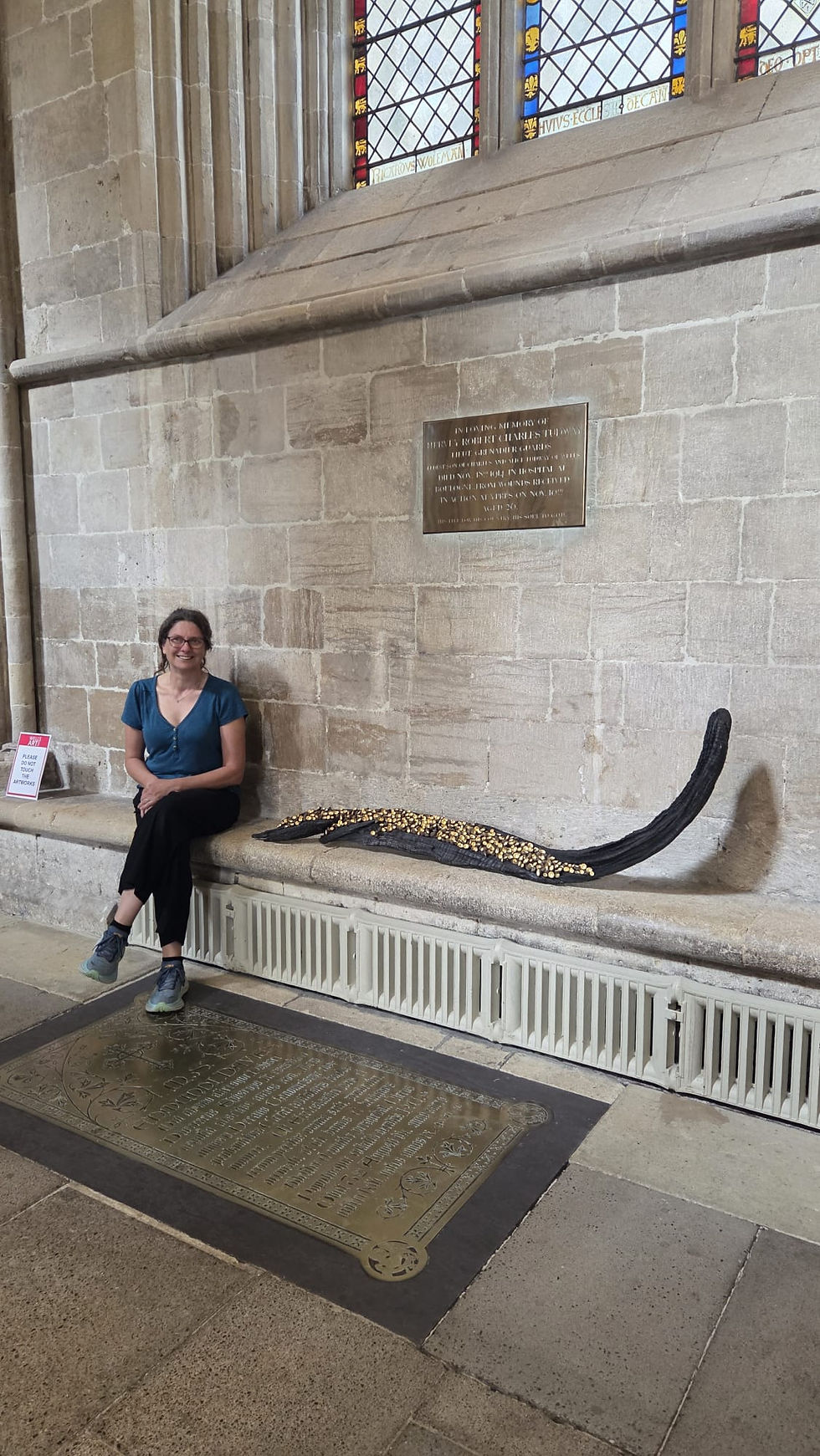

This is such a fascinating project, and I was so happy to contribute. I look forward to seeing more of Christin's work.