

Student Stories: Charles Worvill and Sarah Johnston draw in parallel

Context
In the first of this series of posts on collaborative drawing, we discussed our drawn response to music created by exchanging a physical drawing through the post in reaction to Igor Stravinsky’s The Rite of Spring.
This time, we wanted to create a single drawing online while working simultaneously, albeit from different locations. After reviewing several digital whiteboards, we chose one that seemed relatively straightforward to use, and following an initial session learning how it worked, we were ready to experiment.
Process
We had already decided that networks would form the basis of the drawing. Rather than
beginning without direction, we chose to work from visual prompts connected to our
individual course projects. One prompt was a section of an old road map, the other a
graphite drawing of a plant root system which we uploaded onto the whiteboard.

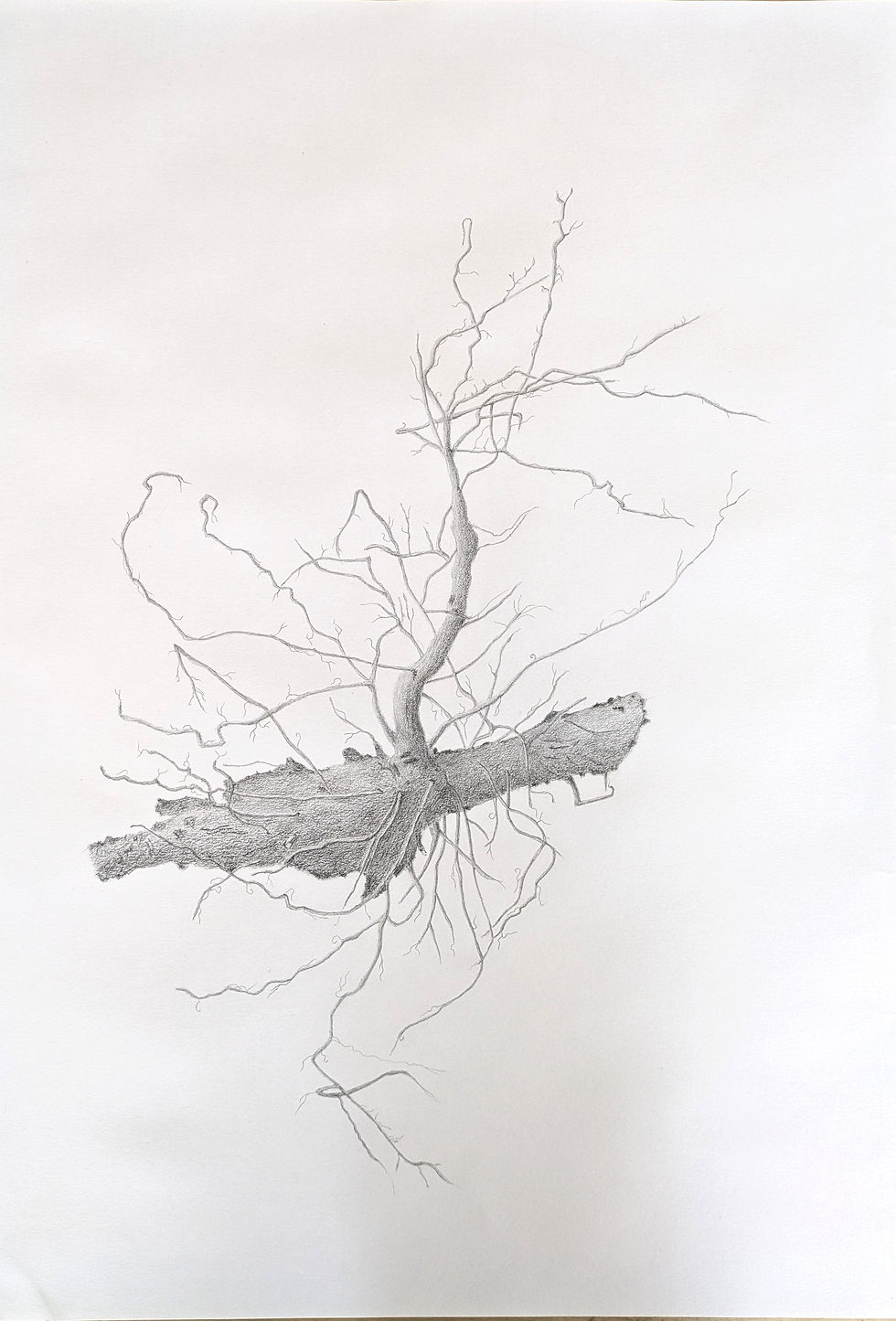
It quickly became clear that both images shared similar visual characteristics: lines
meandering outward like the channels in a tidal delta, from originating nexuses. We
overlapped the images to create continuity between them, establishing a framework for a new collaborative drawing providing opportunities both to expand on the existing motifs and develop new ones.

The collaborative drawing itself took place on a separate layer above the reference images, rather like working on tracing paper. Unlike traditional drawing, however, the online system allowed us to work independently and simultaneously. This dialogical process became a kind of graphical conversation. Seeing each other’s marks emerge introduced spontaneity and prevented us from overthinking the work. Instead, we allowed the drawing to evolve naturally.
Although we had access to a wide range of colours and drawing tools, we initially gravitated towards dark lines and tones, perhaps influenced by the imagery of roads and roots. In a second attempt, on another layer, we deliberately introduced colour using dots and dashes to suggest varying densities within the route and root systems: purple represented the densest areas, green less dense areas, and orange the sparsest.
Once we felt neither drawing could be developed further, we removed the underlying
prompts to reveal two works comprising entirely our own marks. The final image merged both drawings into a single composition, demonstrating the level of cohesion we had achieved through collaboration (see the image at the top of this post).

Reflection
Charles: I was intrigued to see how the dialogical approach would work, feeling
apprehensive about how I would react to seeing Sarah’s marks appearing, apparently
spontaneously, and unsure whether to respond immediately to what I was seeing or to focus on recording my own marks. The collaborative relationship was further complicated by our chatting about the work as we were making it, and it became gradually clear to me that the drawing was arising out of a combination of unpredictable visual and aural influences operating in real time.
Sarah: I think I imagined a less controlled outcome, but because we were new to
simultaneous collaborative drawing, we needed some structure to guide us, hence the visual prompts. This was partly about learning the system as we went along. At first, it felt slightly disconcerting to see marks appearing beside mine which I had no control over, and I found myself avoiding areas where I thought Charles might be heading. Chatting throughout the process inevitably had some bearing on the outcome. I think there was also an unconscious level of compromise in the way we worked together. Next time, I would aim to be more inventive and to introduce other elements to this method of collaborative drawing, such as collage.
Conclusion
Dialogical drawing can be approached in different ways, including face-to-face collaboration, but working remotely loosens control over the outcome, as a blind drawing would do. The uncertainty that this introduces into the process can bring surprising results, beyond what we may have initially envisaged. We would definitely encourage fellow students to try this method of collaboration as a way of re-energising and expanding their creative practice.
For more information about potential applications of a dialogical drawing process, see the work of Koulidou et al (details below).
Reference
Koulidou, N. et al (2020). 'Drawing on Experiences of Self: Dialogical Sketching.' in Proceedings of the 2020 ACM Designing Interactive Systems Conference (DIS '20).
Association for Computing Machinery, New York, NY, USA, pp 255–267. [Research paper
online] Available at: https://doi.org/10.1145/3357236.3395513 (Accessed 14/05/2026).


Comments